Available, as usual, here.
I really have very little else to say about this one. It was a summer action blockbuster that did nothing impressive yet had no glaring points of suckage, either. I’ve been calling it “barely good,” and I think that sums it up best.
My girlfriend later confessed to me she went with me because it had Jake Gyllenhaal. That’s fine. I got to watch Gemma Arterton.
As Americans, it’s our cultural heritage to spend more money than we make. Your income may be a hard, fast number, but it’s much more of a suggestion than a limit. What I’m getting at here is unless you put yourself in debt, the massive institutions of legal usury aren’t going to be able to buy their underground city with the stoplights where the only color is gold and the streets are paved with the credit cards of starved debtors. We need that city. If Apophis blows us all to hell, it’ll be the only place we have left.
But say you’re a selfish un-team player who (unlike the world’s forward-thinking big businessmen) cares nothing for the long-term survival of humanity. Say you’re following some stupid career that makes you little to no money (actually, given that qualification, “stupid” is probably redundant). And in the most unlikely assumption of them all, say you intend to spend less than you earn.
Among the chief components of executing this America-destroying plan is to identify repeated expenses and decide if they’re necessary. If they’re not, your solution’s simple. Quit spending money on them, Monopoly Man With Your Dopey Little Monocle.
If they are necessary–and I’m using the term loosely here; I, for instance, like to own so many socks my closet looks like the corner of a cotton mill–see if you can’t minimize the expense. Shit adds up. If you buy a $3 mocha every day on your way to work, you’re dropping $60-70 a month on coffee.
Buy a $60 espresso machine. Get a thermos. Learn to make your own mochas. Reduce monthly coffee expenditures to $5 of beans and $5 of milk. Yay! You’ve still got delicious coffee and you can cut a few hours from your regular job to focus on writing/underwater basketweaving/Chewbacca sculptures etc.
But wait, there’s more. Ladies like a dynamic guy. (Men may like a dynamic partner, too, if only because a girlfriend with hobbies of her own gives us more time to work on our own ridiculous hobbies.) I think, subconsciously, women evaluate every man they meet by his capability to survive a zombie apocalypse. Looking all big and strong is the no-duh part of this, but having skill sets is an even bigger part. Knowing tae kwon do: an obvious plus. Cooking, too–the apocalypse is filled with bad meals. If you’re aware of the eldritch secrets of heat and salt, you’ll be worth your weight in shotgun shells. Even something unglamorous like knowing how to sew or change a tire is attractive.
Allow me to put this in terms we can all understand. In D&D, most of your character’s power comes from his skills. If you want to be high-leveled in real life, you need to develop skills of your own. And what is the art of concocting espresso-based drinks if not a modern form of potion brewing?
Learn to do stuff for yourself instead of buying those services from others. It’ll cut back on your day job and make you sexier. Besides, you think any of those banker fucks know how to brew their own espresso? You’re going to be in pretty high demand in the underground city.
Why isn’t this book selling? First, let’s rule out a few variables.
1) The writing blows goats.
As mentioned, I’ve already sold most of these stories somewhere. You know how hard it is to sell a single story, anywhere? Even to a market that pays the princely sum of $10? It’s pretty fucking hard! Even those markets reject 90-99% of the stories they see. They get a lot of material and only buy the stuff they really like. That doesn’t mean what they buy is the awesomest thing since dinosaurs fighting with shotguns, but it does imply a baseline quality. Either the writing or the story or both were enough to hook an editor who reads scores of stories a month. I’m not gonna get all “Kneel before Zod” here, but I’d put the writing in When We Were Mutants & Other Stories up against the average self-pubbed Kindle title no worries.
2) The packaging (title, description, cover art, etc.) is the blowful part.
The price is $1.99. That’s right in line with this market. Still, I’m dropping it to $0.99 to see if that changes anything.
Whatever else you might think of the book, you gotta admit that’s a sweet title.
I’ve written several hundred movie reviews in the last three years. I know how to write a hook. The description may not sell ice to a wampa, but it’s fine.
The cover art’s more subjective–it’s definitely not your run-of-the-mill “photograph of a hot chick with some huge sans serif text pasted over it”–but I happen to think it’s pretty damn cool. It’s eye-catching. It’s nontraditional, and maybe that’s turning people off, but I feel like it’s a great representation of the work.
3) I’m not a very talented whore.
I haven’t done a ton of self-promotion. This is true. But the places I’ve promoted it have been the right places. Result: nothing. I should send it out to some review blogs and see what happens there. I’m getting the impression recommendations from trusted sources are a big factor in selling unknown works. That, uh, may not be news to anyone.
Here’s some variables that might make a difference.
1) It’s a short story collection.
Konrath, and nearly all the self-pubbed authors I’ve seen, sell novels. Maybe people hate reading short stories. Maybe short stories threw sand in their faces as children. Maybe, for some reason, customers aren’t interested in buying them when there’s all these actual novels available just a click away. I could address that by listing a previous novel of mine and seeing how that does, but I’m kind of busy with this detailed dissection of a niche subject right now.
2) I’ve only got the one work available.
Konrath writes about success coming from “shelf space,” or having a number of different titles for readers to find, get engaged by, and scoop up the rest of your work. I think this is a really strong point, actually. Single-title self-pubbers may find it much more difficult than people with 3+ books online.
3) My fiction career doesn’t have much of a platform.
I suspect this might be the biggest fly in the ointment of selling your work to strangers. Thing is, if you’ve already got a decent chunk of readers, they’re not really strangers anymore. They’ll pick up your book on your recommendation. Suckers. These suckers, in turn, will recommend it to their friends and communities. Hooray! Sales!
I’ve actually got the opportunity to increase my platform here by a ways, which I intend to do just as soon as I’ve beaten The Legend of Zelda: The Twilight Princess again. Hyrule’s in danger, people.
Conclusions, Week One
Caveat: these are preliminary conclusions based on an initial week of data. That’s very little info, really. At this point, Shit Is Subject To Change.
I’m honestly not disappointed in these results. My expectations were low–people can’t shut up about ebooks these days, and I wanted to see for myself what it’s like to actually try to sell one.
However, it seems to me that ebooks do not, despite all buzz to the contrary, sell themselves. To achieve sales, you need either a preexisting readership or to do a lot of self-promotion. Again, this really isn’t news, but I mean you need that just to sell a copy. So far I could sell more books through bagpiping in the subway than by listing them on Kindle.
My initial suspicion is the amount of time you need to spend self-promoting is not going to be worth it. For authors seeking a career, that time is, in almost all cases, better spent writing, or at least pitching your writing to agents and editors. Because until you reach critical mass, you will have to keep pumping your own work All. The. Time. Self-promotion is a hydratic beast with an empty belly. It demands constant nourishment or it will eat you instead.
Well, possibly not, at least about the eating you part. Again, my opinions could change if the data does. But for now–and Konrath says this himself, to his credit, though possibly he should say it more often–the self-epubbing route is not a game-changer for those of us who aren’t already established. In fact, so far it resembles the bulk of my fiction career: a bushel of effort for a withered cherry of financial gain.
Well, maybe not. But you gotta have a catchy title to draw them in.
Joe Konrath, who writes novels under the name J.A. Konrath, is the leading light of self-publishing electronically. His ebooks are on pace to make him more than $100,000 this year. On Kindle alone. He’s done so well Amazon is publishing his next work. He blogs with great transparency about his sales and methods. Lest there be any confusion about what’s to follow, let the record state I think he’s a cool guy, and that it’s wildly awesome he’s been able to seize such a successful independent career.
I, like dozens, possibly thousands of others, was inspired to follow his lead. Last week, I uploaded a collection of my short stories to the Kindle store. I see it as a very low-risk, high-reward venture: I’ve already sold six of the eight stories here. The seventh was previously self-published as part of a charity event. The eight and titular story’s a strong one, but none of the major markets I submitted it to picked it up.
I probably could have sold that story to a smaller market, so my lost opportunity cost was $10-50. It took a few hours to format the text properly, and several hours more to cajole my sexy talented girlfriend into finishing the cover art. That’s it. I’m still seeking the normal route to publication for my sci-fi novel, The Roar of the Spheres.
You know how many copies of WWWM&OS I’ve sold so far to people I don’t know personally? Zero. None. As our friends south of the border would say, absolutamente nothing!!!
Yet I didn’t just post it and move on, like a fire-and-forget missile made out of words about wizards. I introduced When We Were Mutants & Other Stories on kindleboards.com and did some light interaction. I introduced it in the proper section of the Amazon boards. I mentioned it here, and linked to it from the sidebar. Results: nothing.
Not quite the outcome I was expecting after reading up on Konrath’s blog.
Let’s be clear–I wasn’t expecting to be able to fund a wardrobe of gold top hats and sable-fur tighty-grayies off this, either. I would have been happy with $10 a month. Seriously. I hoped to repeat this with other collections down the road and build a small but steady income stream to supplement the other ways I make money, e.g. dancing on the sidewalk for nickels.
One week is not enough data to draw any strong conclusions over. It’s just another production of Small Sample Size Theatre. But so far, my experiment is showing me it’s not as easy as the self-epublishing all-stars make it out to be. I’ll plunge into analysis in my next post.
My car’s a piece of crap, but it starts up whenever I turn the key. Most times I don’t even need to yell at it. I’ve got an old TV, a DVD player, a Wii, and this laptop. I have a nice coat I bought a couple years ago and a small collection of signed books. Other than that, the most expensive thing I own is probably my fishtank and its assorted apparati–and it’s a freshwater ten gallon.
I think I can count on one hand the number of DVDs and CDs I’ve bought this year. I’ve got a lot of books and a small DVD library, but both these collections accumulate slowly.
I don’t not buy things for some moral or spiritual reason; if I look like a monk, it’s coincidence, not purity. I think monks go to church sometimes. They’re also not supposed to be this fond of vodka.
I’m lucky in that I seem to lack the consumer gene–it just doesn’t occur to me to buy things, although that may be a byproduct of never having money–but my amaterialism is also a product of valuing my writing career more highly than I value.. whatever it is people buy. New cars? Jeans so stiff you need pliers to get into them? TVs so huge they could double as a supporting wall? (Okay, now that one I do want.) Every hour I spend at work piling up fat stacks is one less hour I have to devote to honing my skillz. One hour further away from living as a professional in the field I want to work in.
That’s the real reason I don’t buy stuff. Stuff isn’t worth it, and neither’s what I have to do to make the money I’d need to buy it. Trust me, when I have money, I’ll buy a flatscreen TV so huge I’ll have to knock down a wall to make room for the team of elephants it’ll take to deliver it. But when I buy that TV, it’ll be with money I made doing what I’ve always wanted to do.
In the meantime, I don’t need it. When you know why you don’t need it, it’s no trouble to forego.
Many people who want unorthodox careers–writers, actors, cartoonists, artists of all kinds, underwater basketweavers and snipe hunters, kung fu fighters and professional fluffers–spend their early years in careers that have nothing to do with their dream. As lawyers. Computer programmers. Salesmen.
Fuck that. I’ve wanted to be a writer since I was 12. I’m not going to wait until I’m 30 or 40 or 60 to start living like one.
At this point in time and space, we all need money. Most of us have to work for it. If you don’t, please leave your address and when you’ll next be out of the house. If you do have to work, if you have to put time in what’s known as a “real” job to support your quest for your “fake” one, take a look at how much time you’re putting into the former and how much into the latter. If the first outweighs the second, quit.
I’m not kidding. You’re making too much money. Either find more time for your fake job or cut back your real one. Your fake job won’t become a real career until you start treating it like one.
Or for a long time after that. Which is why you should get serious about it right now.
The money of a traditional career might be a safety net, but it’s not a very good one. Your corpse won’t end up any more nutritious than mine. I don’t want you standing behind a counter helping people buy slacks with someone else’s name on them. I want you lying on your floor in your pajamas sculpting Chewbaccas out of pipecleaners because that’s what you want to do with your life god damn it. So quit making money and start making pipecleaner Chewbaccas. If you try that for ten years and you’re not one step closer to making a living at it, you know what, late-stage capitalism will still be out there. They’ll still need dentists and retailers and personal trainers.
But at least you tried, and failed, to do what you really want, and probably had a lot more fun even when you were failing than you would have tallying someone else’s cash flow or selling someone else’s product.
I want to be a writer. I’m living like one before I can make a living as one. It’s pretty fucking fun. Failure ahoy.


The Red Sea
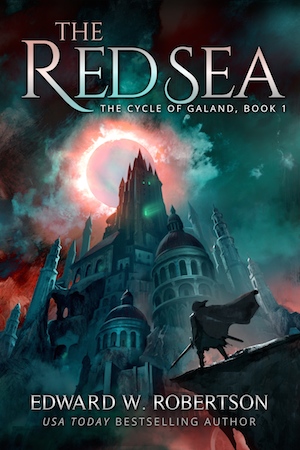
When Dante Galand was just a boy, his father Larsin sailed away to make his fortune. And never returned. Since then, Dante has become a great sorcerer...
More info →


- Fantasy (5)
- Science Fiction (16)
- Breakers (11)
- Rebel Stars (3)
- The Cycle of Arawn (4)
- The Cycle of Galand (1)