short stories
“10%” just got picked up by The Future Fire. Looks like it’ll be running in their June issue, meaning I got two stories appearing next month. Let the preparations for intense self-Googling begin.
That’s four acceptances in the last three months. My formerly robust supply of unpublished works has dwindled to a mere five pieces–I’m sitting on the welcome problem of selling faster than I can write. Clearly the solution is to bounce my future submissions through a gauntlet of pro zines before trying anywhere else; in the time it takes them to rack up all those rejections, I can build up a new backlog of material. Andale.
It took me two and a half weeks rather than two, but my latest story, “When We Were Mutants,” is finished. I think that’s my all-time favorite title. It’s actually the first time I’ve come up with the title first and written a story around that.
I’ve currently got just two stories out in submission with another four waiting to get blasted back into circulation, a cosmic imbalance I intend to correct over the next 24 hours. We shall see if the veritable laundry list of publication credits I’ve stumbled into the last couple months has any effect on their success. Guessing: no.
Sold “The Long Hunt” to Tower of Light. Clearly on to something here. Plan: spend more on champagne than I made from the sale.
Recently had “Every Song Is a Love Song” accepted by OG’s Speculative Fiction, a midmarket magazine that I like for reasons I’ve forgotten.
This is my fourth sale now, all of which have come in the last year, a condition which I have probably unreasonably interpreted to mean I’ve hit the point in my career where most of what I write will eventually end up published somewhere. I still write the occasional piece of garbage, and I currently have more stories in submission than placed–barely–but given the ratio of stories written : stories accepted, it feels as if I am doing something right. Needless to say this is an extremely new sensation.
Propelled by stupidity, I’ve decided to write a new short story every two weeks, a pace that’s twice as fast as the best I’ve mustered in the past. The extra-smart part of this plan is I launched it just as I was getting into a new relationship. Failure ahoy? Oh, you better believe it.
I am currently on pace through New Story #2. If I’m finishing New Story #15 at the end of December, I will be mightily impressed. Bonus points if I haven’t alienated everyone I know.
It’s hardly new, but in October my short fantasy story “The Werewolf of Narashtovik” ran in Reflection’s Edge. I forget whether I’ve mentioned RE before, but I like them, and not just because their editor seems to like me. They’re a broad-genre webzine that runs about six times a year. Good place for unpublished authors. And needless to say, their taste is impeccable.
I’ve got another short slated for M-Brane. Think it’ll be issue #5, in June. This is a young mag run by an interesting guy with a good head on his shoulders and the ambition to turn it into a pro magazine (if that happens, I should probably suggest retroactive pay bumps for all former contributors–that’s how these things are done, right?). I can see myself submitting there again.
The local paper has granted me a second column about weird, cult, and otherwise interesting-but-little-known movies. I honestly don’t know the URL for the web version yet. Will dig that out later. Had to cut my day job down the four days a week to keep up with all the work I’m doing for the Herald, which means I am 20% of the way towards my dream of not working at all.
Finished a story last night for a Jim Baen’s Universe contest. Will no doubt fail, but I mostly wanted a deadline for myself.
There’s the last six months. Could have been worse.
Um, there are going to be spoilers for Cloverfield and The Thing to follow. Really though, if you haven’t seen them yet, renting and immediately watching them would be a better use of your time than reading this.
I’m currently in the middle of writing a story where everyone dies at the end. I know this is a classic no-no; the conventional (and usually correct) wisdom is that killing your characters at the end is a dramatic copout for writers who can’t think of a real ending for their story. It’s a big fat cheat, and the only thing America hates worse than a loser is a cheater. Also, “and then everyone died” is kind of nihilistic. It’s something teenagers write. Nobody wants to write like teenagers, including teenagers.
But obviously there are exceptions. It can be done well. The Thing and Cloverfield are Exhibits A and B. So how come they work when so many other “whoops dead” stories don’t? What makes them so special? Most important of all, what can I steal from them to make my own fucking frustrating almost-finished story work, too?
I think I get The Thing. Kurt Russell and Keith David, the last survivors, are clearly going to die at the end, but it’s not so much that they’re being killed by something as they’re making the choice to die. And not only is it a choice rather than a condition imposed on them, it’s a moral and logical choice: if one of them’s infected, and they live to bring that out into the world, then the world’s toast. Killing themselves/each other is an enormous fucking sacrifice; it doesn’t get much more noble than giving up your own life to preserve the rest of humanity. Oh, yeah, that’s why Danny Boyle’s recent Sunshine worked, too.
Resolved: everyone can die if it’s for a cause.
“Getting eaten by a 350-foot giant fucking monster” is not a cause, yet somehow Cloverfield’s ending feels right and proper. I’ll admit a strong wave of some emotion that translates roughly to “Oh hell no, Hud just died?!? Boo on that,” but that was swept away by that ending, which felt both sad and earned. I guess it was a little more in the Greek tragedy mold, where Rob’s hubris kept him from getting together with Beth until the ending, at which point it was too late to avoid getting bombed into vapor.
Yet again, work gets in the way of what’s important, so I must cut this short. But a lot of what Cloverfield’s about is terror coming from nowhere. It’s senseless and unstoppable. A lot of average people die. In that light, killing all the characters is natural; it’s not really a cheat when the whole point is that, by definition, a tragedy’s something a lot of people don’t escape.
I’d like to claim I’ll be thinking about this stuff a lot tonight, but I envision a long series of procrastinating to Futurama commentaries instead.
About Me


Recent Posts
Archives
Reapers
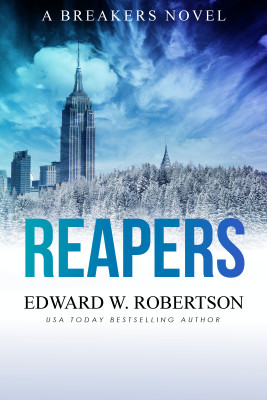
When the plague came, federal agent Ellie Colson fled into the Adirondacks with Dee, the daughter she barely knew. They began a new life as subsistence...
More info →






- Fantasy (5)
- Science Fiction (16)
- Breakers (11)
- Rebel Stars (3)
- The Cycle of Arawn (4)
- The Cycle of Galand (1)