Here’s me! I had no clue this website existed until moments ago, when I was following the fine tradition of googling myself rather than finishing the story I must finish today, and already I feel compelled to update this so my pieces in Reflection’s Edge, written as Ed Robertson, are also included. Time for some sleuthin’!
I am, as noted below, soon to be jobless. This is going to give me all kinds of opportunity to do things I haven’t had time for recently, like catch up on all that new porn the internet keeps grinding out. Among other neglected tasks I hope to get to, I started learning wing chun kung fu last year and after I’d dedicated myself to it for a while–long enough to get past the stage where I thought I could punch cars dead in their tracks, and actually noticed the changes and patterns of the learning process–I picked up all kinds of parallels to what you go through when you learn to write.
I may not be able to get to this seriously until next week; I’m still working out the last of tenure at the bookstore, and along with the nonstop movie reviews, my submission for Chris Fletcher’s Aether Age anthology, and my personally interesting but publicly tedious personal life, I don’t see myself having the chance to dive into it until then.
But I wanted to get this up, if only to force myself to finally write it. We’ll see how it goes next Tuesday.
I quit my day job a couple days ago, you see, meaning in just under two weeks the only income I’ll be receiving for a while is from writing. It won’t be enough to provide a sustainable living–I quit for “my job was growing increasingly sucky”-related reasons, not because I’m finally making enough from freelancing to do nothing else–but it will be enough to pay the rent while my bank account slowly dwindles.
I figure I could go six months before I need to start seriously looking for a new job. I’m going to write a lot. I’m going to continue submitting my backlog of short stories. And I’m going to start querying my last novel again and see if the combination of better query letter + several actual writing credits gets any bites.
Unless I go on some mad short story-selling bender–quit pretending you don’t want to pay me fat stacks of cash, Asimov’s and F&SF–there’s no realistic way I won’t have to end up taking a new day job sooner or later. Even if my novel sets the agenting world afire, finding representation and publication is going to take longer than my savings can hold out, no matter how fast I race my advance to the nearest Chase.
But it looks like, for half a year or so, my only job is going to be writing. I’ll be doing exactly what I’ve always wanted to do with my life. That should cheer me up when at this point next year I’m manning the counter at the Exxon down the street.
Postscript: Got some writing that needs doing, imaginary blog audience? Drop me a line. My credits are over there on the right side of the page and I’ve got a snazzy English/fiction degree from NYU, if that’s the sort of thing that turns your crank. We’ll work something out.
It’s difficult to know the right path to take when you’re pursuing a ludicrous career in fiction. For a long time, you make no money at all, and pass the time pouring your days into work that gets sent to people whose replies, cunningly impersonal though they may be, essentially boil down to “No one wants to read this.”
But writing is personally rewarding, and besides, that voice inside keeps telling you these people are fucktards and you are talented and one day they will realize this and go “Oh, why couldn’t I see this at the time” while weeping big salty tears into their tea, which you’ll never get to see unless you keep it up. That would be the greatest tragedy of all.
What do you do after failing for a while, then? Try something new. A new novel. Or set aside the long form for a while and crank out some short stories, then when those all rack up rejections until you’ve lost all faith, sit down and consume 3-9 months producing another novel no one wants to read, and once you confirm that it’s time to go out and plow through another half dozen stories. Because trying the same thing you failed at last time would just be crazy: just think about all the exciting new ways you can find to fail.
Rather than admitting you’re just mucking around blindly, it’s nice to pretend to have some sort of goal.
When I got through revisions of my last book around September ’07, I sat back and thought “Well, this pretty much kicks ass. Time to write some short stories and finally get them published so agents will take me more seriously when I start sending this around.”
That was my goal: get 3-4 short stories published somewhere, anywhere really, just something I could write on a cover letter besides my college lit mag. I’d done plenty of literary fiction in college workshops and a few more in the years after, but these were the first SFF shorts I’d written. I had my first acceptance appear in the April ’08 issue of Reflection’s Edge, thought “Well, that’s fucking awesome, and so am I,” then didn’t sell anything else until I sent another to RE for their October issue. Months pass; nothing. (By nothing I mean I sent lots around and grew increasingly confused as to how everyone else could possibly be that stupid and/or I could possibly be that bad.)
Sale to M-Brane SF mid-February. Sweet. Keep writing at my fairly slow pace. Sale in late April to OG’s Speculative Fiction–well booyah. Over the next two weeks, I land pieces on Tower of Light and The Future Fire. That’s six stories in five markets; none of them are monsters, but together they’ll look pretty good, I think.
Oh rad. I hit my goal. I even made a little money.
Oh fuck. Now I need a new goal. Now I need to get published in a pro magazine.
That’s where I’m shooting now. I’m looking around at a lot of the names in the places I’ve got pieces upcoming and I see a trend: a lot of people hit a streak like me where they may have been working for years, but once they hit that first sale, within a year they’ll have three or six or ten. A few of them, like me, are just hitting that streak. Others did it a few years back and might have a couple dozen stories out there. Of these, some have a listing or two in a pro mag.
Presumably, of this sub-subset, a fewer still go on to sell novels for fat stacks, make Big Names for themselves, get laid nonstop by sci-fi groupies, etc. I’ll do that. For now, the next step, I think, is to crack those pro markets. Wish me luck.


The Cycle of Arawn: The Complete Trilogy
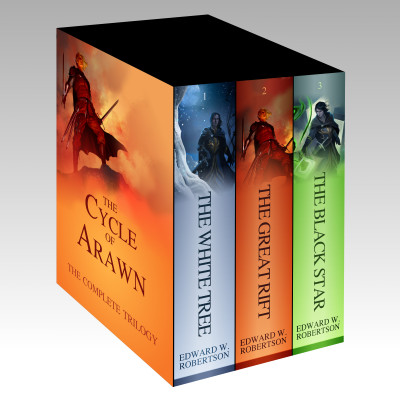
Dante Galand is young. Penniless. Alone. But devoted to learning the dark magic of his world. His quest will take him from the city gutters to a foreign...
More info →



- Fantasy (5)
- Science Fiction (16)
- Breakers (11)
- Rebel Stars (3)
- The Cycle of Arawn (4)
- The Cycle of Galand (1)